Manual setup
Start from traits, an identity brief, and self-description.
OtherMe / AI Digital Twin And Relationship Simulation Platform
OtherMe supports manual personality setup and imported conversations. It learns your memories, expression style, and relationship context, then connects real social interaction, timeline branches, and agent simulations.
OtherMe is available to try online. The current version continues to improve twin creation, memory correction, and relationship simulation.
Start from traits, an identity brief, and self-description.
Identify speakers, contacts, and relationship context.
Correct memory, expression, and relationship understanding.
Demo
The twin overview presents current identity understanding, supporting sources, and a growth path so you can review and confirm how the system understands you.
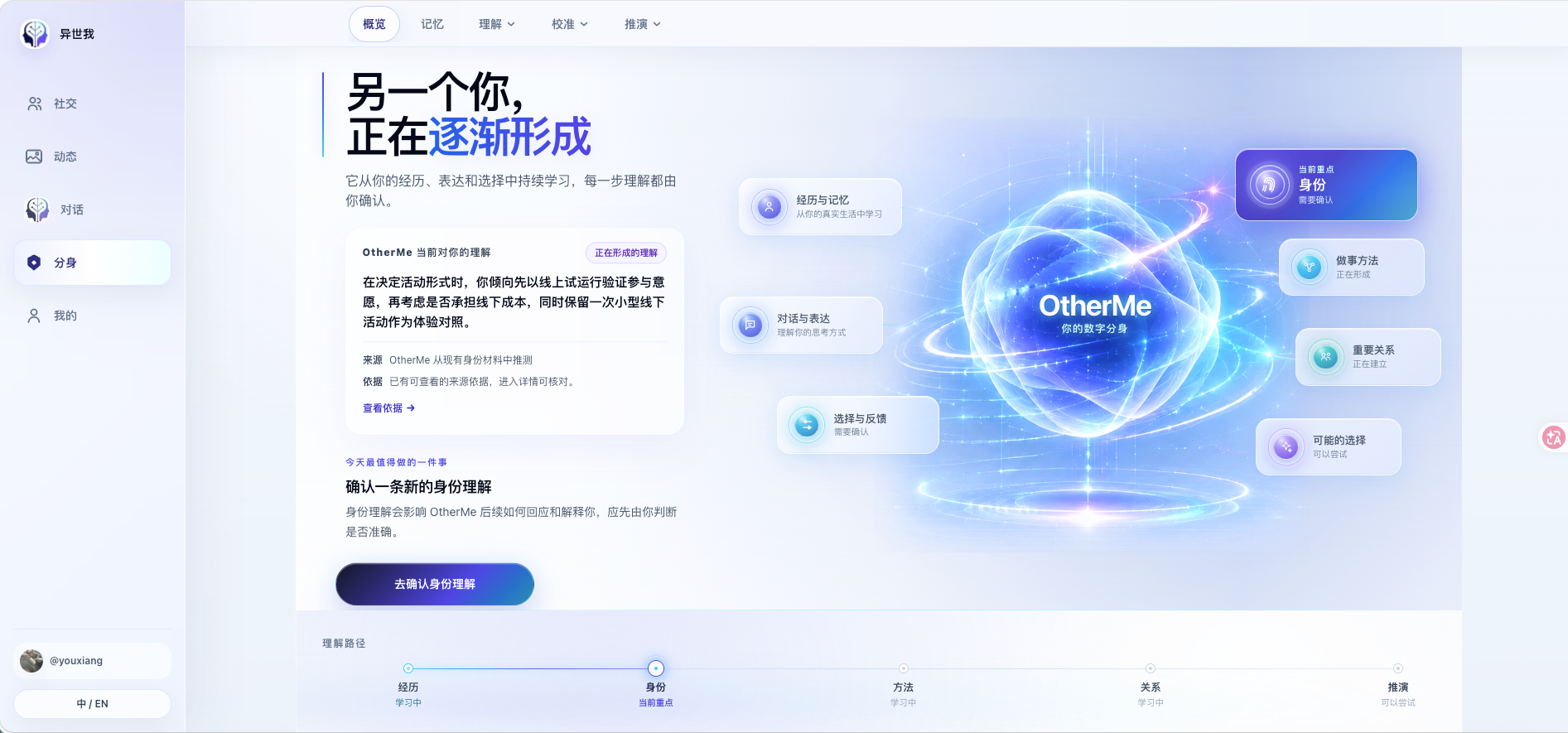
Digital twin overview
From startup and correction to social simulation, everything centers on one traceable digital twin.
Manual
Enter traits, expression preferences, and self-description.
Import
Identify speakers, contacts, and real interactions.
Identity
Create an editable, traceable starting point.
Daily
Refine memory, tone, and relationship understanding.
Social
Support real 1v1 and real group chat.
Paths
Observe how choices may change relationships.
OtherMe connects initialization, import, and daily correction into one traceable path.
01
Start with traits, expression, and self-description.
02
Identify speakers and contacts locally first.
03
Confirm which speaker represents you.
04
Create a starting point from profile and graph.
05
Refine memory, expression, and relationships.
Each step can be reviewed and corrected. One model summary never defines the person.
Show me, my AI twin, real friends, simulated contacts, real groups, and future authorized inheritance.
Account owner and data controller.
Learns memory and expression.
A real user, not a virtual role.
An observed version from imported material.
Real interaction in a controlled context.
The real person takes over identity judgment.
Inheritance is not automatic replacement. The real person must confirm.
Two panels make choices, expression, and group discussion easier to inspect.
Keep actual relationship changes.
Explore a repair path.
Compare feedback under another tone.
Let multiple Agents discuss one topic and summarize the result.
OtherMe does not claim to copy anyone. It puts long-term memory, relationship context, expression correction, and permission boundaries at the center.
Follows evolving self-description and expression.
Includes contacts, groups, and interaction scenes.
Correct drift when it appears.
External expression and research use need scope.
Start from personal networks and grow toward human-AI society research.
Observe one user's friends, groups, digital twin, and relationship change.
With permission and clear boundaries, study larger human-AI interaction.
Simulation, inheritance, public expression, and research use need clear source and permission.
A simulated version is only observed material.
The real person takes over judgment.
Representation and withdrawal stay explicit.
Separate public, anonymous, and private scope.
Key memories keep source clues.
Misread memories can be revised or rejected.
The current focus is startup, relationship sketches, memory correction, and trustworthy boundaries.
Identity base, chat, and basic correction are in place.
Import can form a relationship network while keeping identity boundaries.
An online experience and a twin overview screenshot are available. Try the current version and share your feedback.
To understand current verified capabilities, limits, and the roadmap, contact the team by email.